
How to Find Who Owns a Richmond City Property
Start with an address and end with the recorded instrument. The Assessor keeps ownership details in the annual roll. That office ties each property record to a parcel number. The Clerk records deeds and related interests. Finance manages the tax accounts, while GIS maps the parcel shape to the address. Each system answers a different question. Follow every step. Do not treat one name field as final proof of who owns the Richmond City property.
- Search the Assessor’s Property Search with the parcel’s primary address or a known owner name.
- Copy the exact 11-digit tax map/PIN and compare the situs and mailing addresses.
- Search the Clerk’s SRA land-record index for the newest deed and confirm its grantee and legal description.
- If an entity or fiduciary holds title, check its public filing or related probate record for context.
- Use the correct office for any follow-up: Assessor for roll data, Clerk for deeds, Finance for tax accounts.
The route is deliberately narrow. It surfaces the name shown in public ownership records, but it does not identify an occupant or prove that a recent closing has reached the annual roll.
Richmond City Assessor Owner Field
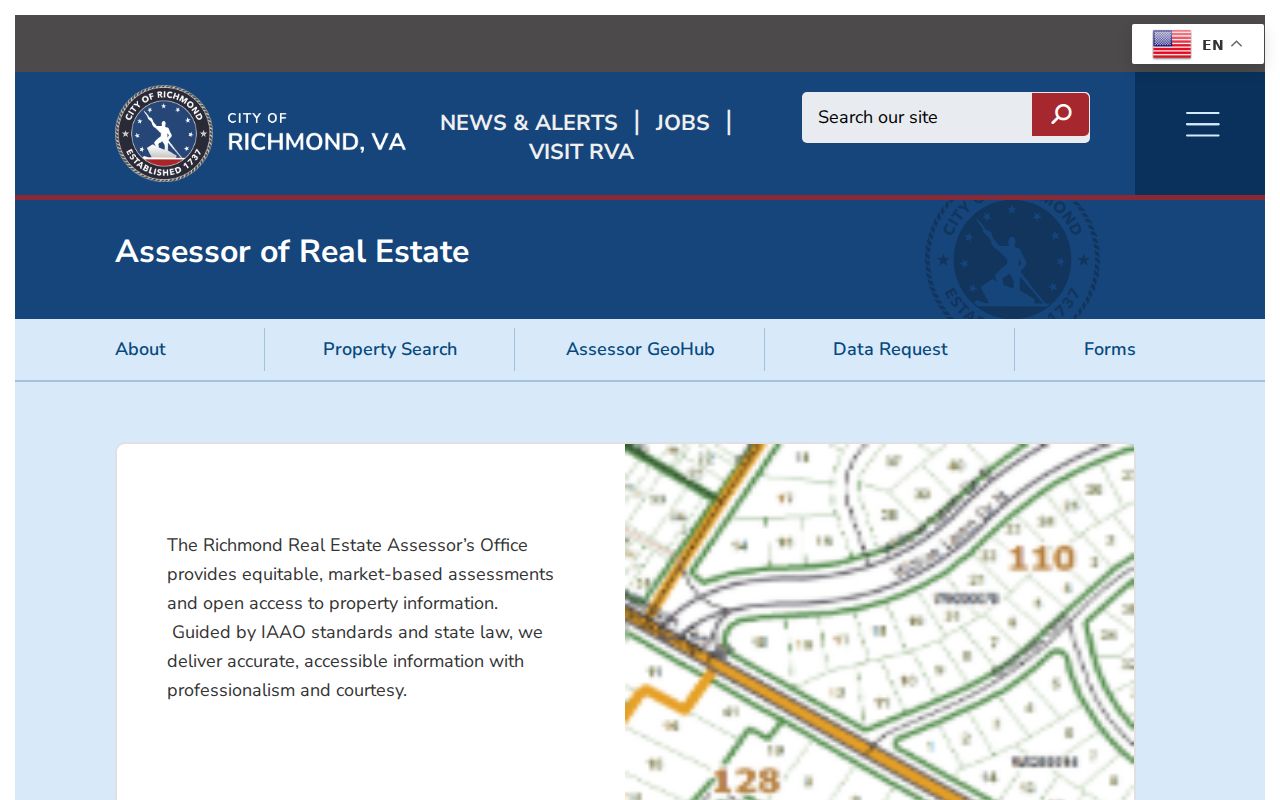
The Assessor's public Property Search is hosted by DataScout. It offers searches by owner, property address, and tax map or PIN. The city describes its record service as covering ownership information, parcel characteristics, and current sales data. Refresh dates for the card data are not published. Treat the owner field as a snapshot of the assessment roll. Check the deed for any newer transfer. The image links to the Richmond City Assessor's property-service page. That page opens Property Search, forms, exemptions, and appeals.
Corrections and data requests go through the Assessor's office. Call 804-646-7500 or stop by City Hall at 900 E. Broad St., Room 802. Staff there can sort out owner or primary-address questions when the hosted search falls short. Updates to the roll after a deed have no fixed timeline. The city gives no promised turnaround.
Confirming a Richmond City Owner by Deed
A deed shows the grantor, grantee, recording date, instrument reference, and legal description. Match those fields to the Assessor card. A newer deed points to its grantee. That person may be the more current owner of record. Names alone can be ambiguous. So confirm the PIN and legal description cover the same land. Richmond SRA separates its newer Indexing Search from the Online Index Books. It also keeps a Historical Records Search. Division I covers land north of the James back to 1782. Division II includes old Manchester south of the river and reaches 1874. Choose the correct division for older or pre-1993 records. Images require an approved subscription at $50 monthly, six months prepaid. The Record Room and written copy routes remain available. Copies run $0.50 per page, and certification adds $2. The Record Room can be reached at 804-646-6530. A recorded deed beats a stale owner field. But it is not a complete title search.
Where Richmond City Owner Names Appear
Several public records can name an owner in Richmond City. Each name serves a different purpose. The assessment roll ties a parcel to the tax-roll owner. A deed names the parties to a recorded conveyance. SCC records identify business entities, and GIS maps the parcel itself. Pick the record that answers your question.
| Source | Owner Info It Gives | Access |
|---|---|---|
| Assessor roll | Owner name, mailing/situs clue, parcel traits and assessment | DataScout, phone, City Hall or data request |
| Clerk deed index | Recorded grantee, grantor, date, instrument and description | SRA index, counter or written copy request |
| SCC CIS | Entity status, address, formation and filing context | Public online entity search |
| GIS parcel map | Parcel shape, city boundary and planning overlays | Parcel Mapper and Assessor GeoHub |
An owner name does not reveal who occupies a house. The mailing address may belong to an out-of-city owner, a business, a fiduciary, or a tax-notice contact. A deed proves a recorded transfer but can carry exceptions or related instruments. The roll and deed comparison settles current ownership. Prior owners come from following the chain backward. The strongest match joins identity and land. Compare the deed's grantee with the assessment owner, then confirm the legal description and 11-digit PIN point to the same parcel. A matching surname alone is weak evidence. That risk grows on a large urban block with multiple owners. If a deed lists several grantees, review the vesting language and later instruments before calling one person the sole owner.
Richmond City Mailing and Situs Addresses
The Assessor's situs address marks where the parcel sits. The mailing address is simply where tax bills and notices go. They often differ. Neither one proves where the owner actually lives. Read them as record fields rather than personal facts. Richmond's Planning and Development Review unit maintains a Central Address Database. Yet the Assessor still keeps a single primary address even when utilities or emergency responders rely on other operational addresses for the same parcel.
Before hunting deeds with an address, check it against the PIN and the legal description. A just-recorded deed can leave the tax roll and bill address lagging behind the new instrument. Permit searches need their own normalization. Use the street number and name only. Drop street type and punctuation. Add a direction if the portal expects one. When a one-digit address still fails after a retry, call or visit instead.
A tax mailing address is not an invitation to contact someone. Use public owner details for lawful property research, title due diligence, and civic questions only.
Richmond City LLC, Trust and Estate Owners
Plenty of Richmond parcels are vested in an LLC, a trust, an estate, or another fiduciary. Many sit in those names rather than in a person's. Start with the exact grantee name in the deed index. Then confirm the land through the PIN. Virginia's SCC Clerk's Information System can add entity type, status, formation date, registered address, and filing context. Treat that as business identity information. The recorded deed, not the entity record, still controls the land interest.
Estate property moves in its own ways. Ownership may pass through an executor or administrator deed. It may instead take the form of a will-based devise, a fiduciary deed, a partition, a deed of distribution, or a probate order authorizing a sale. The Circuit Court Clerk's probate section holds the wills and fiduciary files. Call 804-646-6540 for that record path. A will states intent, but it is not always a recorded land transfer. Confirm the resulting instrument in SRA before relying on it.
Names rarely match perfectly across records. Compare entity suffixes, trustee wording, estate captions, and recording dates. Two similarly named companies or people are not automatically the same owner.
A transfer to a trust or company may name an individual only as trustee or manager. The assessment roll may shorten or normalize that name while the deed preserves the formal vesting language. For an estate, the probate file can explain who had authority to convey. But the deed or court-authorized instrument is what you follow into the parcel chain. When the owner card and the instrument disagree, ask the Assessor about the roll entry. Ask the Clerk about the recorded filing separately.
The SCC search helps separate an active business from a dissolved one and adds filing context. A registered-office address, though, is not necessarily the parcel address. Match the exact entity name and deed date against the property PIN before calling it a match. The Virginia SCC business search combines entity information with UCC and tax-lien lookup routes on one interface.
Use each source for its own purpose. The entity page gives identity context, the deed proves the land interest, and the Clerk's separate record holds any filed instrument affecting the parcel.
Richmond City PIN and Deed Alerts
Richmond's 11-digit tax map PIN is the strongest identifier the city has. The Assessor, GIS, deed index, and VADeed Alert all share it. The Clerk requires the number on the first page of covered real-property instruments. Copy it exactly. The city has published no verified breakdown of the digits. Do not guess at their meaning. Pair the PIN with the owner name when searching. A party-name typo can otherwise hide the property's record.
VADeed Alert is a free, voluntary notification service. It matches an enrolled owner name or PIN against qualifying recordings. It can flag a new filing. It cannot stop a deed from being recorded, insure ownership, or replace a title review. Open any alert inside the official index and read the actual instrument.
A Richmond ownership search is most reliable when the owner field, PIN, legal description, and deed date all agree. If one element differs, contact the custodian of that record instead of treating any single portal as conclusive.
Limits of a Richmond City Owner Search
The public roll names an owner for assessment purposes, not an occupant. No search result exposes every legal exception, unrecorded claim, or protected address. Virginia's Address Confidentiality Program can shield an eligible person's residence address. Protected-voter rules also limit what addresses appear. Do not try to expose a protected location.
Use Richmond property records for a purchase, an estate question, or a tax review. They also serve public accountability. For a deed, ownership, or boundary dispute, turn to the Clerk, a title professional, or an attorney. A licensed surveyor may fit the problem better.
Lawful use. Richmond City records support lawful property research and due diligence. Using an address or owner name to stalk, harass, threaten or target anyone can violate Virginia law.