
How a Richmond City Property Search Works
Know what you need before you open anything. The assessment owner, the latest recorded grantee, a tax balance, and a parcel outline are four different questions. Each has a different custodian. Write down what you already have. That means the full address, any direction or unit, the owner spelling, and any PIN. The Assessor is the right first stop. Its owner name, primary situs address, and tax-map number bridge you to the Clerk, Finance, and GIS. Note where each result came from. A later deed or tax bill can then be checked against the correct source.
The Assessor offers three public search modes: property address, owner name, and tax map or parcel number. The search runs through DataScout, linked from the city's Assessor page. Field labels and required flags appear on the portal itself, so check them there before entering your terms. Richmond's standard Tax ID runs 11 digits. Copy it from an official result rather than adding guessed hyphens.
One result is only the first step. The route here turns a name or street address into a parcel key. It then brings in the right record custodian for confirmation. Remember that the Assessor keeps a single primary address. The city's central address system may list utility or emergency locations for the same parcel.
- Search the Assessor’s public Property Search by the best known street address, owner or PIN.
- Record the owner name, mailing and situs addresses, and the 11-digit parcel number shown.
- Open the matching map parcel or address info box, then use Drilldown from inside the city parcel.
- Use the Clerk’s SRA index to find a deed by party and historical series; request the image or counter copy when needed.
- Use Finance for bill or delinquency questions and the Online Permit Portal for work history.
Richmond City Search Fields and Limits
The hosted search lives under the city Assessor's service, not a single citywide land-record index. The city describes owner, address, and parcel lookup. But it does not publish whether the form supports suffix filters, wildcards, partial strings, or downloads. Treat those details as portal-specific. Confirm them on screen. If a search comes back empty, vary the street spelling or try the PIN. Do that before concluding the parcel is absent. The Assessor can tell you whether an address or owner entry needs correction.
No owner result should be assumed from the link alone. The table here separates the confirmed modes from the details the city does not publish. Never assume a wildcard rule, an exact-match rule, or a fixed result limit. Check the current screen yourself.
| Advertised Field | Format | What Is Confirmed | Open Question |
|---|---|---|---|
| Owner or current owner | Name text | Owner-name search is advertised | Partial matches and required flags were not visible |
| Property address | Street address | The Assessor keeps one primary address per parcel | Autocomplete and unit handling were not captured |
| Tax map/PIN | 11-digit number | It is the cross-office parcel key | Do not invent a digit pattern or punctuation |
The city's Assessor page is the canonical starting point. It carries the DataScout link, the search forms, and a phone fallback if the portal stalls. A saved legacy application URL may open a redirect. Follow its updated link rather than treating the redirect page as a parcel result.
The current search destination is hosted at Richmond City DataScout Property Search. That link identifies the destination itself. It is not a sample parcel card.
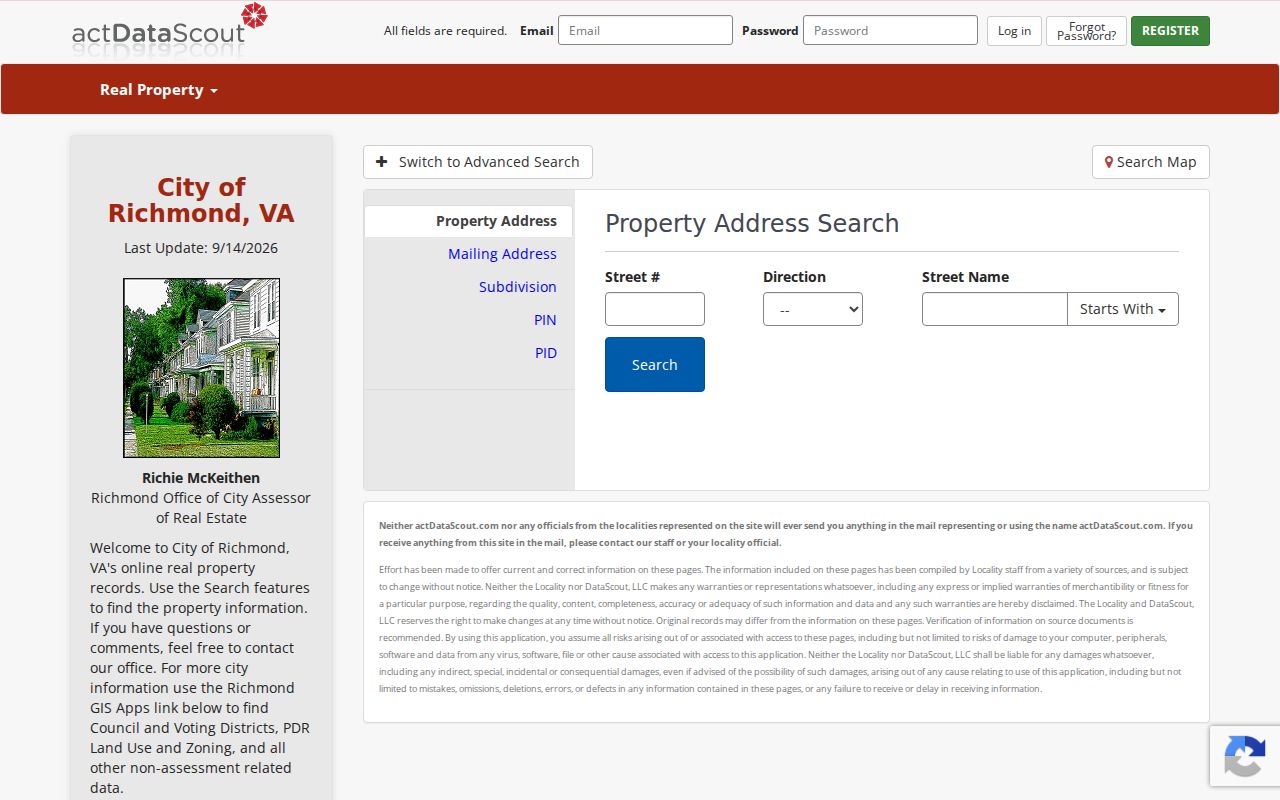
Use the city's official link if DataScout is unavailable. The Assessor can help with a parcel card, a data request, or an owner-name or address correction by phone, email, or at City Hall.
Richmond City Address Search Details
An address is a discovery key, not a legal identifier. A corner parcel can carry a site address on one street. Its recorded description may reference another street or a numbered lot. Units, rear buildings, alleys, and street renumbering can all split the older wording from the current tax card. The Assessor maintains one primary address. Yet the city's Central Address Database can preserve extra locations used for emergencies or utilities. Save the exact address each system displays. Use the PIN to reconcile them.
Try the Assessor's primary property address first. A tax-bill mailing address is a different animal. It may belong to an owner, a bank, an attorney, or a post-office box rather than the property itself. Planning and Development Review maintains city addressing in the Central Address Database. Meanwhile, the Assessor stores a single primary address. A parcel can therefore carry operational addresses that never appear in the property search field.
Permit history plays by its own address rules. In the Online Permit Portal, enter the street number and street name only. Omit punctuation and street type, and add a directional abbreviation when needed. The city warns that one-digit addresses may fail. If a normalized search still misses, visit or call the Permit Center. The permit portal and the Assessor do not accept identical input.
Keep the full legal description beside any shortened address. Old city directories and deeds may reflect a prior street name, block, or lot. They may not use today's postal format. Compare the address, the owner, and the PIN before deciding two results describe the same parcel.
Richmond City Property Search Redirects
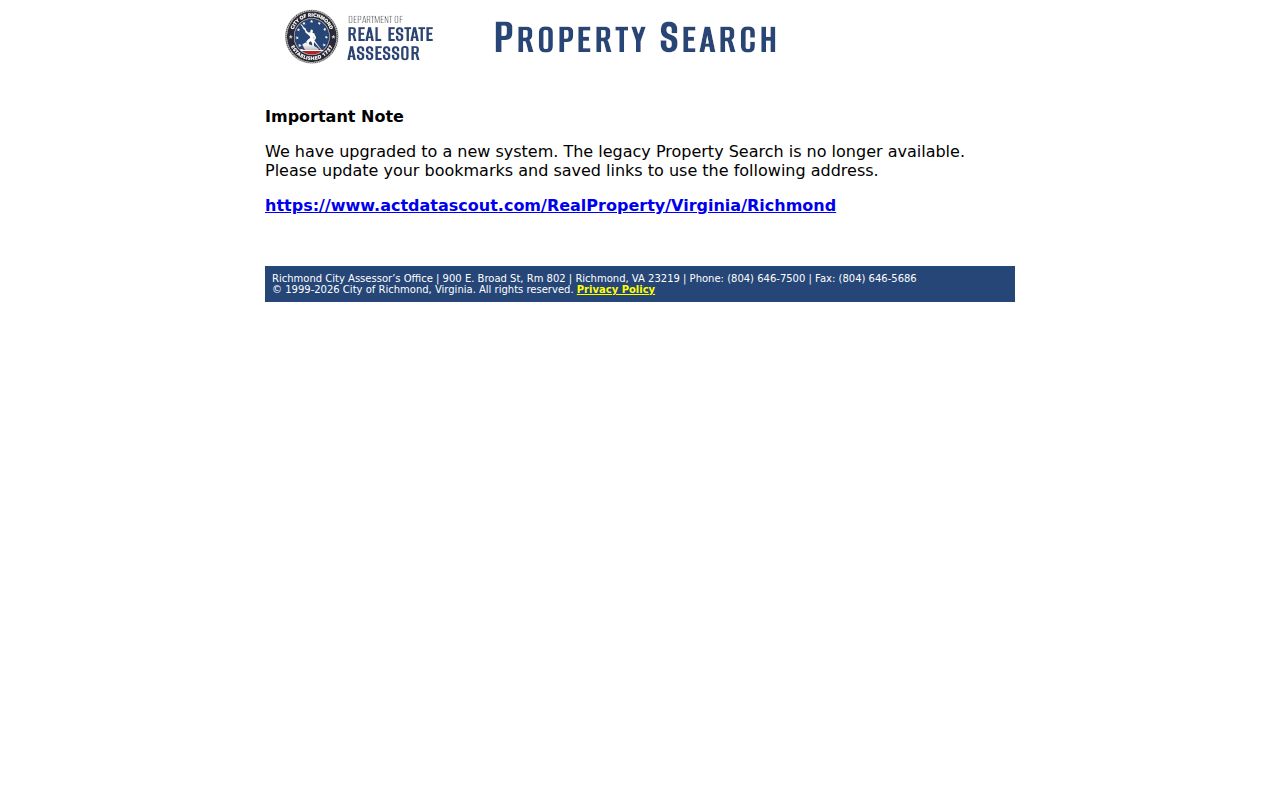
Do not trust a bookmark by itself. A redirect notice is routing, not a result. It cannot display a parcel's owner, value, or history. An old bookmark may still open the retired Richmond property search address. But that page now forwards users to an upgraded service. Treat the notice as an explanation of the move, nothing more. Before typing an owner name or address into any form, confirm the City Assessor links to it as the current service. If the new provider is temporarily inaccessible, contact the assessor instead of paying an unrelated search company for a substitute report.
Keep the parcel PIN after a successful search. It travels across systems better than an address does. A saved link may no longer show the form a property owner remembers. Trust the assessor site for the link.
The image below connects to the former Richmond City search address. The city explains the move to the new host there. It helps when a bookmark still points there.
Make sure the new result truly belongs to the City of Richmond. A Richmond postal address can sit in Henrico or Chesterfield, so match the jurisdiction before relying on the property record.
What a Richmond City Property Record Shows
Every result is a snapshot from the office that produced it. The Assessor card centers on taxable land and improvements. The Clerk index tracks filed instruments and parties, while Finance follows billed amounts and transactions. GIS maps parcel geometry with overlays. A field labeled "owner" on one system may refer to a different date or purpose. It may differ from the grantee named in a recorded deed. That difference matters. Save the source name and retrieval date with anything you copy.
The assessor describes its public record service as offering ownership information. It also covers parcel characteristics and current sales data. Exact card labels are not published. Read each field exactly as displayed. Do not treat any list as a guaranteed screen layout. The PIN and legal description confirm you landed on the property you meant to find.
| Owner name | Assessment-roll owner; verify a recent transfer against the latest deed |
|---|---|
| Primary/situs address | Assessor’s maintained property address; it may differ from mailing data |
| Mailing address | Tax-notice destination, not proof of occupancy |
| Tax map/PIN | 11-digit key carried across Assessor, GIS and deed work |
| Value and exemptions | Annual land/improvement assessment and any visible relief flags |
| Sales and description | Assessor sales data and legal-description details if displayed |
A property search never proves title is clear. The Assessor's owner field is a current-roll lead, not a legal opinion. Its pages promise no fixed closing-to-roll refresh time. A just-recorded deed may be newer than the roll. A parcel sketch is not a survey. Nor is an assessed value an appraisal or a guaranteed sale price.
Searching Richmond City by Owner Name
Owner-name searches work when no address is known. They can surface parcels tied to a person or an entity. Try spelling variants, suffixes, and the exact business or fiduciary name shown on a deed. A deed might index a middle initial, a former surname, a trustee, an executor, or a corporate suffix. Similar names produce false matches, and a trust, LLC, estate, or trustee may appear instead of an individual. Match the mailing address, PIN, and legal description first.
For older holdings, look past the exact spelling. The assessor service does not document every variant it accepts. Treat alternate name forms as entry points. They are not a complete ownership inventory. When an entity appears, the Virginia SCC Clerk's Information System can identify its formal legal name and status. Only a land instrument connects it to a specific Richmond parcel.
For a business grantee, the SCC system shows entity type, status, formation date, registered address, and filings. That helps identify the entity. An SCC address is not proof of land ownership. The recorded deed remains the title trail. If an estate or fiduciary name appears, the Clerk's probate section may hold the related will or order.
No public promise covers how DataScout handles names. It may not accept partial names or return every parcel in one result. Empty results happen for good reasons. Contact the Assessor with the spelling, any known address, and any PIN rather than assuming the person holds no Richmond property.
Richmond City’s 11-Digit Parcel Key
Richmond's standard tax map number runs 11 digits. The deed page requires that tax map or PIN on the first page of instruments conveying or relating to a real-property interest. That requirement makes the identifier unusually portable. It connects the Assessor card, GIS parcel, deed index, and VADeed Alert registration. Copy all eleven digits without inserting a separator.
The city publishes no verified breakdown of the digits into map books, neighborhood prefixes, or parcel parts. Do not infer the neighborhood, block, or ownership type from the number. Do not add hyphens borrowed from another locality's pattern. If a deed or map displays a different format, compare the number with the Assessor before searching by it.
The PIN is most useful in confusing cases. Buildings can share a street address. Mailing information can also point outside Richmond. Covered instruments need the tax map reference on the first page, so the number doubles as a cross-check when an indexed deed lists similar party names. Copy the whole number as shown.
- PIN or tax map number
- The city’s 11-digit identifier used to link parcel records.
- Situs address
- The Assessor’s primary physical location for the parcel.
- Mailing address
- Where notices are sent; it can be outside the city.
- Owner of record
- The name carried on the assessment roll, subject to updates and legal confirmation.
When Richmond City Search Returns Nothing
Every portal fails in its own way. An unavailable DataScout form is a service interruption, not a missing parcel. Clerk results vanish when the wrong division or historical index mode was picked. Permits hide when the address is not entered in the city's shortened format. Finance shows no public bill-search fields, so call 804-646-7000 or use RVA311 when an invoice does not appear. Record the search term and portal first.
A no-result often reflects data quirks. Address normalization, a street renumbering, a spelling variation, an entity suffix, or a recent parcel change can each break a match. Try the primary address, then the exact PIN. If the card cannot be found online, call the Assessor at 804-646-7500 or visit City Hall, Room 802 at 900 E. Broad St. The city also accepts Assessor data requests. Ask the office directly about current request fields and charges.
Missing deeds have a human fallback. The Clerk's Record Room at 804-646-6530 can say which index mode or division applies, and public inspection is open in person. A written copy request should identify the document with party names, an approximate date, a book/page or document number, and the PIN. Fees are collected in advance. Some SRA courts give free index-only access; Richmond keeps image access behind a subscription.
Bills and permits each need another angle. Use Finance's real-estate tax page and its InvoiceCloud payment link for a bill. For a permit, retry the street-number-and-name format. The Permit Center can help when that fails. A failed search in one portal is not evidence that the record does not exist.
Richmond City Search at the Postal Boundary
Richmond is an independent city with no separate Richmond County government. Even so, a Richmond mailing label does not place a parcel inside the corporate boundary. Central ZIP codes run 23219 through 23227, while parts of 23228–23230, 23231, and 23234–23237 extend into neighboring Henrico or Chesterfield geography. For an edge address, compare the Assessor result against the city-boundary map before sending any request to Richmond offices. A postal city is a delivery designation, not a land-record jurisdiction.
When the parcel sits outside the Richmond City line, the neighboring locality's assessor and circuit court clerk hold its property records even if the mail says Richmond. Treat the ZIP as a clue to the location. Then rely on the parcel geometry and legal description to identify the custodian. That check keeps a valid search in the wrong city system from being mistaken for a complete search.
Search by Address, Owner, or Parcel
The best starting key depends on what is already known. An address can point straight to the Assessor card. Its mailing line may not be the property location, though. A name can surface related parcels, but entities and same-name owners call for closer review. Once the right parcel is pinned down, the 11-digit PIN wins. It is the most exact bridge between systems.
| Search Key | Best For | Where It Works | Watch Out |
|---|---|---|---|
| Address | Locate one known property | Assessor, GIS and permit search | Check unit, direction and city boundary |
| Owner or entity | Find records tied to a person or grantee | Assessor, Clerk and SCC for entity context | Separate namesakes, trusts and estates |
| 11-digit PIN | Carry one parcel through offices | Assessor, GIS, SRA and VADeed Alert | Copy it exactly; do not guess its parts |
Not a title search. A Richmond City property search gathers public record leads but cannot guarantee clear title or uncover every unrecorded claim. Use a title professional for a title conclusion.