
How Richmond City Property Records Fit Together
Begin with the question, not the office. The Assessor connects an address to the owner of record, parcel details, sales data and the annual market-value roll. Deeds, deeds of trust, plats, judgments and probate instruments are recorded by the Circuit Court Clerk. Finance handles both tax billings and delinquent collections. The city GIS map ties a PIN to a parcel shape with planning layers. Planning and Development Review keeps permit and zoning files. Richmond City property records therefore form a trail across offices rather than one all-purpose result.
An address works as the easiest first key. The 11-digit PIN is the better link. The Assessor assigns it, and it then carries a property search through every other office. An owner name helps when the address is unknown or the deed chain is the goal. Records sometimes disagree. Compare the legal description and the recording date. A map locates a parcel yet sets no legal boundary, and a tax card names the assessment owner without offering a title opinion.
- Search the Assessor’s Property Search by the primary street address or advertised owner and parcel keys.
- Copy the exact 11-digit PIN and compare the mailing address, situs address and legal description.
- Use the Clerk’s Secure Remote Access index to locate a deed or plat; use the Record Room if the online route stops short.
- Check Finance for the bill or delinquency question, and use GIS to view the parcel and its overlays.
- For a permit trail, search the city’s Online Permit Portal with the street number and name, omitting the street type.
Offices Holding Richmond City Property Records
Each office is a separate custodian. Start from the record's purpose instead of sending one question to every department. The John Marshall Courts Building Record Room supports in-person deed research and copy requests. Recording intake closes earlier than the public counter. The Assessor's City Hall office handles parcel identification, address and owner corrections, annual value questions and mapping. Finance takes bills and collections. Planning and Development Review answers permit and zoning questions. If a portal route fails, the named office remains the authoritative source for its own record.
Richmond is both a city and an independent locality. There is no separate Richmond County recorder or assessor. The Circuit Court Clerk serves as land-record custodian, the Assessor maintains ownership and value data, Finance issues tax bills, and Planning and Development Review runs permits and zoning lookups. The Richmond Room at the public library rounds out house research with historic directories, newspapers and maps.
Richmond Circuit Court Clerk
John Marshall Courts Building, 400 N. 9th St.
Record Room: Monday-Friday, 8:30 a.m.-4:30 p.m.
804-646-6530
Assessor of Real Estate
City Hall, 900 E. Broad St., Room 802
Monday-Friday, 8 a.m.-5 p.m.
804-646-7500
Department of Finance
900 E. Broad St., Richmond, VA 23219
Real-estate bills, payments and collections
804-646-7000 / RVA311
Permit and Zoning Records
Planning and Development Review, Permit Center
900 E. Broad St., Room 108
804-646-1628 inspections
Each office answers one slice of a property question. An address correction goes to the Assessor, not Finance. A recorded deed copy comes from the Clerk, while a tax payment belongs with Finance. Staff can explain access routes, though the Clerk notes that they do not conduct legal, historical or genealogical research for a requester.
Why the James River Changes Richmond City Deed Records
The James River splits more than the Richmond City landscape. It splits the deed records too. The Clerk's office keeps two historical divisions of land records. Division I holds instruments for the north side of the river. That series reaches back to 1782. Division II covers the former City of Manchester, south of the James, through 1874. A combined series also exists. It covers instruments recorded between April 1, 1984 and August 31, 1993. A modern mailing address will not tell you which series holds an older filing. Match the instrument's date and legal description instead. Present street names can mislead a property search.
Current SRA indexing starts with deeds from 1993. Anything older lives in the separate index products or archive screens. Those extend Division I back to 1966 and Division II back to 1937. Material before those years is reached through Online Index Books or the Historical Records Search. Wills follow their own timeline. Their current product coverage begins around 1995 or 1996. Are you tracing a parcel near the river, in old Manchester, or along a historic boundary? Pull the prior deed and legal description first. One index rarely carries the full chain of title.
The Clerk's SRA coverage page lays out the division paths and the remote access options. Its historical reach runs unusually deep for a city this size. Note the difference in access levels. A subscriber image account is not the same as a free public image archive.
Richmond City Assessor Search Keys
The Assessor’s Property Search works with owner names, street addresses and parcel or tax-map numbers. The city hosts it through a third-party DataScout service. That hosting means the search can go down even when the city’s own site is fine. A failed link is not the end of the road. Start over from the Assessor page, call 804-646-7500, or visit City Hall at 900 E. Broad St., Room 802, where weekday hours run 8 a.m. to 5 p.m. and questions go to asktheassessor@rva.gov. When asking staff to pull a record, bring the PIN. Also bring the address spelling shown on the official card, and the exact name spelling.
The city describes the records behind its Property Search as covering ownership, parcel traits and current sales. They are searchable by owner, address or parcel number. The result layout is not fixed in stone. A button, a required field or a display can change. Rely on the official link rather than any remembered screen. Note that the legacy city address now redirects to the newer destination.
The Assessor’s service page remains the stable starting point for the current search link, forms and office contacts. If the hosted form will not open or a parcel cannot be found, call the Assessor. You can also use the City Hall office. A no-result is not proof that land is unowned. Spelling, entity names, address changes and a newly recorded conveyance can all call for a second route.
| Search Key | What It Connects | Use With Care |
|---|---|---|
| Primary address | Assessor card and mapped parcel | Assessor keeps one primary address, though city systems may carry others |
| Owner or entity | Parcels indexed to a person, LLC or fiduciary | Compare PIN and mailing address to separate similar names |
| 11-digit PIN | Assessor, GIS, deed filing and VADeed Alert | Copy it as shown; the city publishes no digit breakdown |
The current Property Search sits on DataScout servers. Use the city's official link whenever an old bookmark lands on the retired application.
The image below shows the current Richmond City property-search destination. The Assessor also handles data requests, address corrections, and parcel questions by phone, email, or in person.
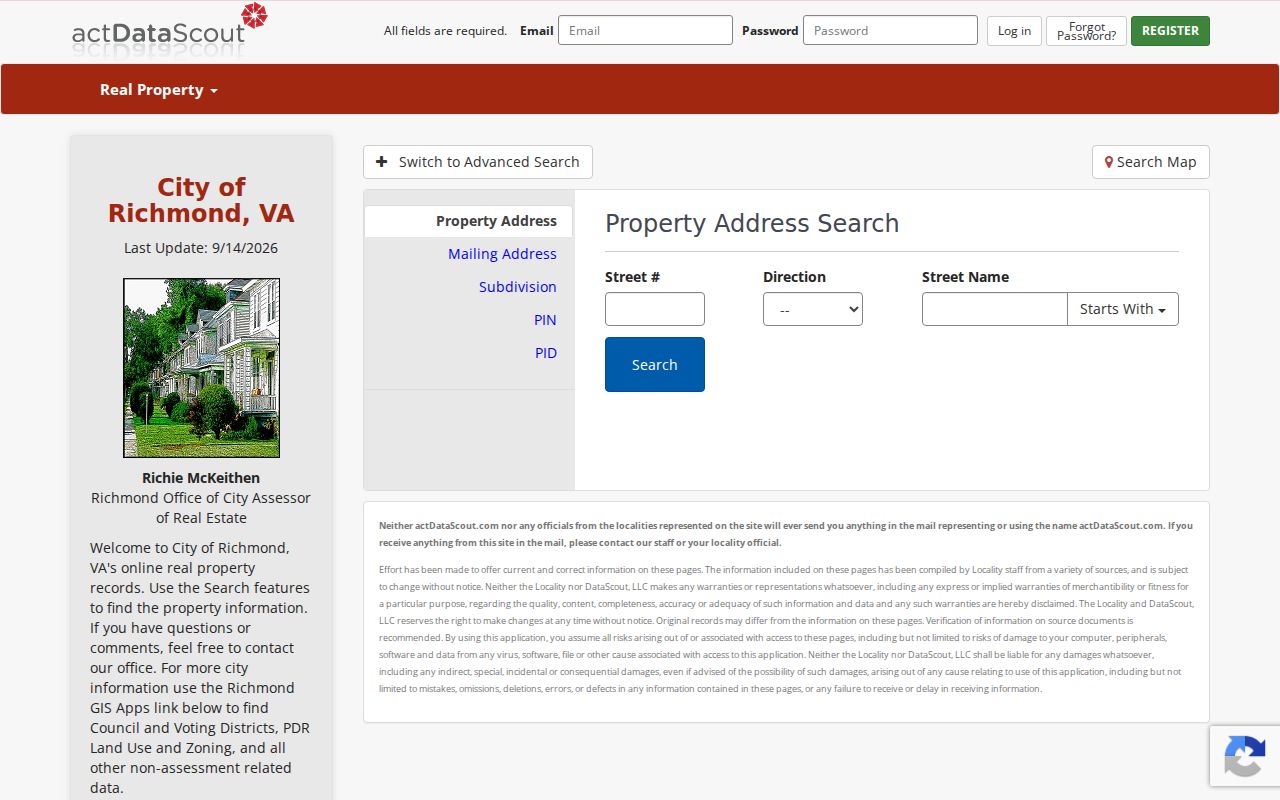
Field labels on the live card include owner, value, exemption, and transfer. Confirm these yourself on the portal. Ask the Assessor for a card copy whenever the display seems incomplete. Treat the portal's marketing description as a description only. The city confirms the search modes. It says nothing about partial-name behavior, result limits, or export controls.
A property address, PIN, and deed can each back up the others. Keep the written legal description even when a map makes the parcel look obvious. Then check the recorded deed date against the current assessment card.
Richmond City SRA Index and Deed Images
Index access and document-image access are two different things. The state SRA site offers a court index interface, but coverage varies by court and images may require a subscription. Richmond's local arrangement costs $50 per month, with six months paid in advance. Verify current terms with the Clerk before subscribing. If online images are out of reach, the Record Room allows in-person review, and the Clerk accepts written copy requests. An index hit only identifies a filing to retrieve. It is not the signed instrument and not a complete title opinion.
Virginia Secure Remote Access, or SRA, is the Clerk's remote index and document system. Richmond's page lists Indexing Search for newer records, Online Index Books for older indexes, and Historical Records Search for earlier books. Statewide guidance notes some courts allow free index-only access. Richmond's deed images require an approved subscriber account. Check the Available Courts list for the current setting.
The Clerk charges $50 per month for remote image access, prepaid for six months, with approval for each subscriber. The counter remains the public alternative. Copies run $0.50 per page, and certification adds $2. Written copy requests are accepted with payment in advance. For a long instrument, call the Record Room for a page estimate before mailing anything.
The image below is the official Richmond SRA coverage and subscriber information. It shows why a name or PIN hit and the document image can follow different access rules.
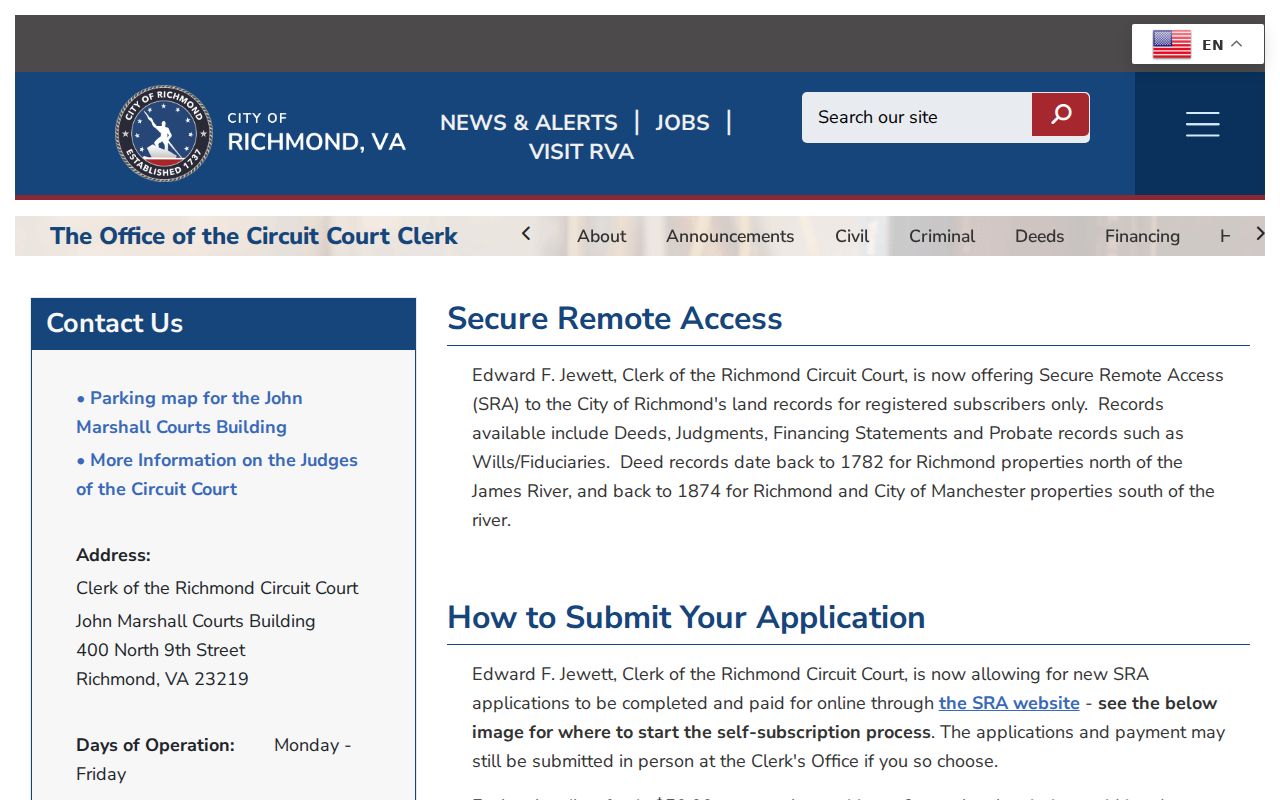
Use the Clerk's page to reach the application, user guide, and current coverage notes. For certified evidence, get the copy from the Clerk rather than relying on a screen view.
Types of Richmond City Property Records
Property records describe distinct events and government actions. A deed records a conveyance. A deed of trust records a security interest. An assessment roll lists taxable value and owner name, while a Finance bill shows charges and payment status. A parcel map depicts the tax parcel and its overlays, and a permit entry describes city review or work approval. Together these documents form a stronger trail, but they are not one unified title file.
| Record Type | What It Documents | Kept By | Access |
|---|---|---|---|
| Deeds and plats | Recorded conveyances, legal descriptions and referenced lot lines | Circuit Court Clerk | SRA index, counter review, paid images or copies |
| Deeds of trust and liens | Recorded interests, judgments, releases and satisfactions | Clerk, Finance or SCC by record type | Land records, delinquent collections and CIS |
| Assessment and sales | Owner file, parcel traits, market-value roll, exemptions and sales data | Assessor of Real Estate | DataScout, office, phone and data request |
| Tax bill and account | Twice-yearly billing, payment and delinquent collection status | Department of Finance | Real-estate tax page, InvoiceCloud, RVA311 or phone |
| GIS and permits | Parcel shape, planning overlays, permits, plans and inspections | Assessor GIS and Planning and Development Review | Parcel Mapper, GeoHub and Online Permit Portal |
Use the deed index to confirm who received a recorded transfer. Then read the instrument and any referenced plat. Finance answers the current bill or delinquency question. The Assessor handles the assessment and parcel card. The Richmond City deed records page focuses on index paths, instrument copies, and historic divisions. Tax bills, exemptions, and appeals live on the Richmond City property tax records page.
Richmond City Assessment and Tax Bill Records
The assessment roll and the tax bill answer different questions. In Richmond, the Assessor values each parcel annually at market value. The office also keeps the owner file, exemptions, parcel traits and sales data. Finance then builds the bill. It applies the adopted rate, credits and collection activity to that assessed figure. The posted rate is $1.20 per $100 of assessed value. Confirm it against the tax year printed on your bill. The city issues real-estate bills twice a year. Read each piece for what it proves. A payment record shows a transaction, not a correct valuation. An assessment notice is not a tax receipt. A tax bill is Finance's account record, not an ownership instrument.
Appeal rights in Richmond run on a strict calendar. Assessment notices go out around July 1 with a July 1 effective value date. An owner may request an Assessor office review within 30 days of the notice. A Board of Equalization application is due by November 30. Hearings begin the following January. A direct Circuit Court appeal is also possible within three years of the assessment year. Prior years, though, carry a written disagreement notice requirement. Comparable sales, property-condition facts and assessment comparisons all count as evidence. The Assessor appeal process page carries current forms and deadlines.
Exemptions follow separate rules. The disabled-veteran program is one class with its own filing steps. Bills can also carry special charges, such as area-encroachment assessments. Compare bill lines against the parcel and permit record. For who owns a property in Richmond, the deed records govern.
Reading Richmond City Parcel Maps
Richmond's Parcel Mapper and Zoning Parcel Mapper stack tax parcels on top of planning layers. Available layers include the city boundary and zoning districts. Other layers cover zoning-confirmation letters, Board of Zoning Appeals cases, special-use permits, plans of development, historic districts, community-unit plans and design overlays. More layers show assessed value, value change, property transfers, year of construction and market-value analysis. The map tells you where to look. The deed or permit file supplies the legal document.
Finding a parcel takes a drilldown. Click inside a parcel polygon. Or use the Drilldown option from an address or intersection info box. A click on a street right-of-way or outside the city may return nothing. Treat map geometry near a fence or driveway as a reference picture only. The GIS division updates splits, merges, subdivisions and alley or road closings. The city makes no custom maps. The parcel layer is not a survey.
The city's interactive mapping catalog links the Parcel Mapper to the zoning layers. A deed may cite a lot, block or line change. The recorded plat is the next stop.
For citywide context, open the Assessor GeoHub map catalog. A GIS map excels at comparing value and transfer patterns across Richmond. Still, the annual assessment notice remains the document to use in a valuation challenge. Precision lives in the plat, not the polygon.
Richmond City Permit and Zoning Records
The city's online permit portal serves two audiences. Anyone can search without an account. The public side covers properties, permits, plans and inspections. Registration unlocks more: applying, paying invoices, viewing personal permits and scheduling inspections. Filters cover permit number, permit type, status, address, project name, applied date, issued date, expiration date and finalized date. Date ranges narrow issued or finalized searches. Search and Advanced controls tighten results; Reset clears the form.
The address search is unusually particular. Enter the street number and street name only. Drop the road type and punctuation, and add a direction where one applies. The city warns that some one-digit addresses can fail. If a repeat search still misses, contact the Permit Center. A permit result is an administrative record. Its status should be read before anyone assumes work was finalized. Look for final inspection or occupancy status when it is visible.
Searchable plan types span residential and commercial building, commercial electrical and mechanical, residential electrical, gas piping, mechanical, plumbing, Certificates of Zoning Compliance and Site Plans. Zoning Administration handles every Certificate of Zoning Compliance through the portal. That office answers at 804-646-6340. The Permit Center is at 900 E. Broad St., Room 108. Walk-ins are welcome weekdays, 8 a.m. to 1 p.m. Phone support continues to 5 p.m. Inspection help is 804-646-1628.
Portal results have quirks. A missing online entry may reflect address form, older coverage or non-digitized material. It does not prove no work occurred. Use the city permit portal guidance when a result needs follow-up, since Richmond keeps its permit, zoning and inspection records in one searchable place.
Richmond City House History Sources
The Richmond Room’s city and suburban directories run from 1819 to the present, alongside newspapers, maps, telephone books, yearbooks and more than 1,500 ephemera files. A directory can bridge a current address to an older street name or block number and can suggest a person to search in a deed index. Listings may identify an occupant or business rather than the landowner, so treat them as a lead. The collections are noncirculating; appointments are advised, and some material may have access limits. The reference desk is at 804-646-0117. The Library of Virginia’s Richmond City Chancery index is a separate path for cases from 1783 through 1879, useful for estate or title disputes that generated litigation.
Work an address across directory years. Note an occupant or owner label, then compare occupation, spouse or widow notation and neighboring entries. Those clues can identify a name for a deed search. The entry shows address history, not legal title. Virginia Chronicle provides free historic newspaper pages, while the Library of Virginia’s Chancery Records Index includes Richmond City images from 1783 through 1879. Chancery cases may hold partition, estate, title or land disputes with plats and heir names missing from a basic deed index.
The image below links to the Richmond Room’s local history collections. Its directory and newspaper holdings can help connect a street address to names and events before you return to the recorded land trail.

Check the deed, census and map for the same years. A newspaper notice may point to an estate sale, street renumbering or building change. Treat it as context, not proof of ownership.
Richmond City VADeed Alert Notices
VADeed Alert is a free, voluntary notification service built on Virginia's SRA platform. Register an owner name or a Tax Map/Parcel ID. When a matching instrument records, you get a notice. Richmond's Clerk page lists the service beside its deed-recording requirements. Those requirements include the local 11-digit PIN. A match is a prompt to inspect a filing.
The alert does not block a fraudulent document. It does not insure title or replace a title search. Keep your registration details current. Save every alert. Confirm the instrument through the Clerk's index or the Record Room. A property held by a trust, estate or business needs the exact grantee name plus the PIN. A personal name alone may miss the filing.
The official Richmond deed and VADeed Alert pages carry the latest enrollment path. The clerk's page also explains the tax-map reference requirement and recording notices.
Richmond City Record Access and Copies
Copies start with specifics. Give the instrument type, party names, and an approximate recording date. Include any book/page, document number or PIN already known. Copies cost $0.50 per page in the Record Room. Certification adds $2, and payment comes in advance. The general Clerk number is 804-646-6505, and the Record Room line is 804-646-6530.
Online access varies by record. The Assessor's property search is open to everyone. SRA land-record images require an approved paid subscription. The Clerk's Record Room welcomes public inspection in person, Monday through Friday, 8:30 a.m. to 4:30 p.m. Recording ends at 3:30 p.m., though the counter runs until 4:30. Staff help with use of the records but perform no historical, legal or family research. A paper request remains a fallback when an image is not online.
Written requests work too. Name the document type and parties, give an approximate date, and add a book/page, document number or PIN when known. The clerk accepts written requests with payment in advance. Finance questions can go to 804-646-7000 or RVA311. The Assessor sits at City Hall, 900 E. Broad St., Room 802. Reach that office at 804-646-7500 or asktheassessor@rva.gov.
Virginia FOIA requests go to the office that holds the administrative record. Describe the record with reasonable detail. Land, probate and other statutory clerk records follow their own access rules. A generic FOIA request does not replace the Clerk's SRA or counter process.
Limits of Richmond City Property Records
Every Richmond City record answers one narrow question. The Assessor's tax roll gives the owner of record for the year. But a deed may have changed hands since. The clerk's deed records prove a transfer was filed. Yet an index can miss covenants, easements, plats, and later releases. A GIS map draws the parcel polygon, not the surveyed corners in the ground. Finance shows the tax bill and any delinquency, not the legal state of title. A building permit only proves the city file exists, not that the work was finished.
These limits still leave plenty of uses. Richmond City property records support title research and purchase due diligence. They also cover assessment review, boundary questions, and civic oversight. For a firm conclusion on title, hire a qualified title professional. For a boundary, bring in a licensed surveyor. Virginia shields certain addresses through its Address Confidentiality Program and protected-voter rules. So leave protected addresses alone. Never use parcel or deed details to threaten or target a person.
Lawful use. Public records support lawful property research and civic review. A lookup is not a title opinion or survey, and using address information to stalk, harass or threaten someone can violate Virginia law.