
The Richmond City Owner-of-Record Card
The Assessor maintains ownership files and the annual land book. Its public Property Search, hosted by DataScout, advertises lookups by owner, address and tax map/PIN. Field names on the live card can vary. Treat the items below as things to check when they appear. They are not a fixed screen layout.
| Owner name | Name carried on the current assessment roll |
|---|---|
| Mailing address | Tax-notice destination, which may be outside Richmond |
| Primary/situs address | Assessor’s one maintained property location |
| Tax map/PIN | 11-digit key used in GIS and covered deed filings |
| Deed reference | Document or book/page clue to confirm with the Clerk |
| Value and sales | Annual assessment and sales data, not a guaranteed sale price |
The owner of record is the name in the assessment system. It does not say who occupies the building. Mailing information shows where tax notices go. That is not proof of residence. For legal confirmation, compare the card with the most recent deed and check that the PIN and description fit the same parcel.
Richmond City Assessor Owner Search
The city's Assessor page links to the current DataScout destination. It also lists forms, exemptions, appeals, GeoHub and office contacts. The hosted search advertises three keys. Use owner name, property address or parcel number, nothing else. A missing result is reason to call the Assessor directly. You can also visit City Hall at 900 E. Broad St., Room 802. The image links to Richmond City Assessor services and Property Search, the official route to the public search rather than a sample owner card.
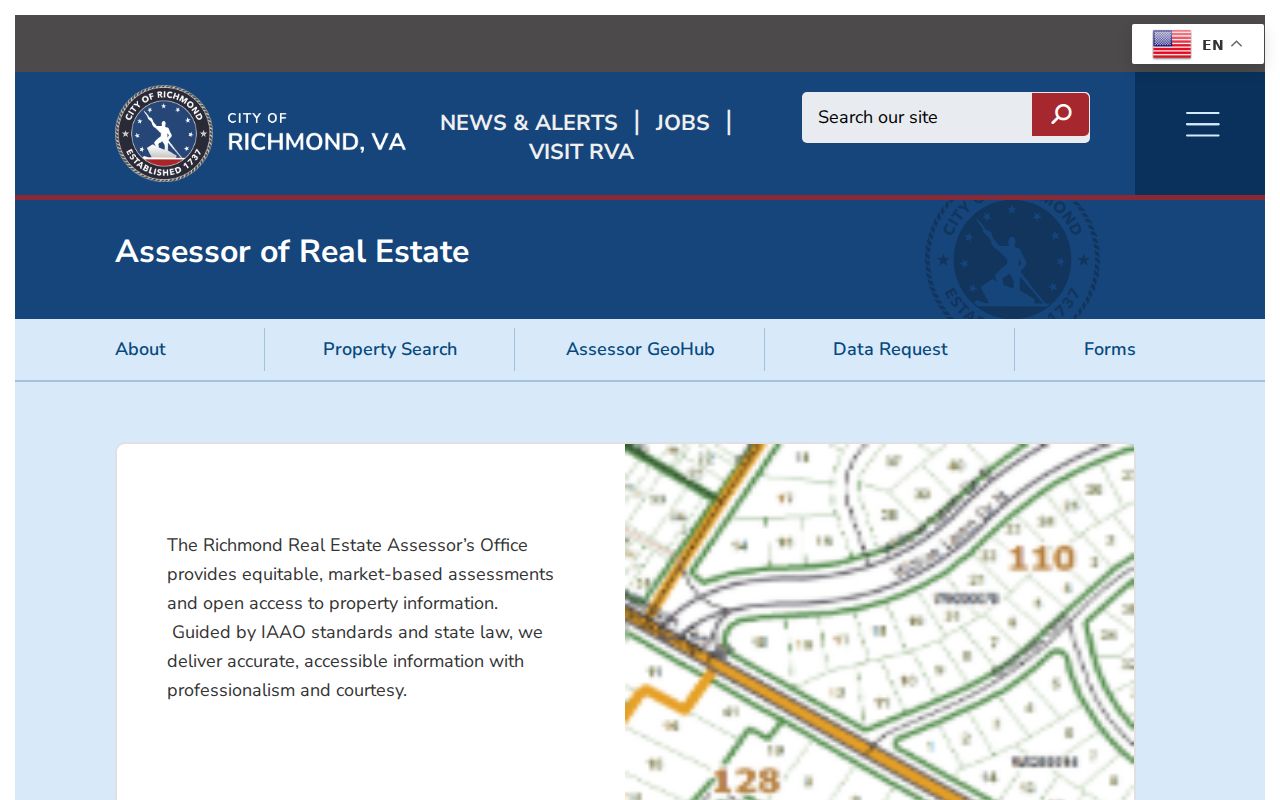
Owner-card and address-correction questions go to the Assessor at 804-646-7500, Monday through Friday, 8 a.m. to 5 p.m. Email works at asktheassessor@rva.gov. The office also handles data requests, so confirm current form fields and any charges with staff before submitting.
How Current Is the Richmond City Roll?
Richmond updates its assessment roll once a year. No fixed number of days separates a closing from an Assessor card update. A recent sale can therefore surface in the Clerk's land records first. The owner field lags behind the deed. Treat any lag figure as a guess, nothing more. Compare recording dates, and call the Assessor when a card seems stale.
Parcel splits add their own timing wrinkle. Per the GIS page, a new parcel reaches the following year's assessment notice or tax bill after deed and CAMA/GIS work finishes. A combined purchase or fresh legal description may not appear in a current display at once. Keep the prior PIN and the new deed reference until the map and roll catch up.
The newest recorded instrument is the real confirmation of a recent transfer. Annual assessments describe the roll's owner and value. They are not a real-time closing feed.
Confirming a Current Richmond City Owner
Start with the newest deed. Confirming a current owner means checking the roll against that recorded instrument. Richmond SRA separates current indexing from older index books and historic records. Pick the right deed series. Then compare the grantee, recording date, PIN and legal description with the assessment card; a newer deed explains any mismatch in the annual roll.
- Open the Assessor result and note the owner name, primary address and exact PIN.
- Search the Clerk’s latest deed index entry for the same PIN or party names.
- Read the recorded grantee, recording date and legal description, including any named entity or fiduciary.
- If the card differs, call the Assessor and ask which record is needed to correct the roll.
- Owner of record
- The name shown in the Assessor’s current roll.
- Grantee
- The named party receiving the interest in a deed.
- Recording date
- The date the Clerk entered an instrument into the land records.
- Situs address
- The parcel’s primary physical address, distinct from the mailing address.
Richmond City Situs and Mailing Addresses
The Assessor keeps one primary property address per parcel. Richmond's Central Address Database can hold several utility or emergency addresses, so a secondary operational address may not surface as the tax-card location. A situs address says where land sits. A mailing address says where a bill is routed. Neither field alone proves who lives there.
When two addresses appear, use the PIN and legal description. Finance routes real-estate mailing-address changes through the Assessor. That split matters when a tax bill goes to a lender or former owner after a sale. Finance answers payment questions. The Assessor updates the property mailing data.
Permit searches need a normalized address. The city asks for street number and name only, with street type and punctuation omitted. Keep the full address in notes so the portal format never replaces the legal description.
Richmond City Entity and Fiduciary Owners
An owner field may name an LLC, trustee, executor, administrator or estate. Read the exact vesting language on the deed. Use the PIN to confirm the parcel. The Virginia SCC Clerk's Information System shows entity status, name, formation date and registered address. That explains who the entity is, but it does not confer land title or replace the deed.
Fiduciary wording points toward probate. Richmond Circuit Court probate may hold a will, estate file or order, and the probate section answers at 804-646-6540. A will may explain the intent, but the land trail needs a recorded executor, administrator or fiduciary deed, distribution instrument or order.
Never assume a registered agent owns the property. An entity address is not the parcel's location. Match names, PIN and legal description every time.
Richmond City Tax Bills and Owner Records
Finance bills real estate twice each year, while the Assessor manages the ownership file and property mailing address. A lender’s mortgage-escrow data can affect where a bill is sent without changing title. In 2025, Richmond reported that a mortgage data import issue sent bills that usually went to lenders directly to residents. That was a billing-route problem, not proof that the deed or owner record had changed.
When a bill or payee seems wrong, compare the tax account with the Assessor card and newest deed. Contact Finance at 804-646-7000 or RVA311 for billing, and the Assessor at 804-646-7500 for owner or address data. Keep the notices and receipts. Do not use the bill envelope as the only source for the current owner.
Correcting a Richmond City Owner Entry
Start with the paper trail. If the Assessor roll lags behind a recent recording, pull the deed reference and call the office. The Assessor sits at City Hall, Room 802, and answers questions by phone, email, or in person. Bring the parcel PIN, the current card, the recorded deed, and any address correction material you have. The office publishes no standard correction timeline. Ask what it needs and when to check back.
A different problem needs a different office. When the deed index itself looks incomplete, contact the Circuit Court Clerk's Record Room at 804-646-6530. That office takes written copy requests with advance payment. Public inspection happens in person Monday through Friday, 8:30 a.m. to 4:30 p.m. Remote images require an approved SRA subscription. A property tax payment still belongs with its proper custodian, and so does an ownership correction. The Richmond City ownership method walks the wider route from address to assessor card to recorded deed.
Richmond City Owner Record Limits
An assessment roll has honest limits. It cannot confirm where someone actually lives. It also does not capture every form of control over a parcel. Some Richmond owners rely on protected addresses through Virginia's Address Confidentiality Program. Protected voters can also have home addresses withheld from public voter information. Never try to unmask a shielded location. Public records serve lawful purposes. These include a property transaction, an estate matter, or an assessment appeal.
For a real title question, go deeper. Review the full deed and related filings with a title professional or an attorney. An owner lookup is a smart first check, nothing more. It is not a title search. It is not a legal opinion. It is no guarantee that the annual roll has caught up with a new recording.
Lawful use. Use Richmond City owner records for property and civic research. Stalking, harassing, threatening or targeting a person with address information can violate Virginia law.