
Richmond City Property Value Types
Value information for a Richmond City parcel comes from more than one place. The Assessor maintains annual market-value assessments, ownership files, parcel characteristics and current sales data on its roll. A recorded deed documents a transaction between parties. A Finance account and its tax bill show the charges tied to the assessment. Keep these meanings separate when you compare a parcel with a recent sale or a neighboring property records entry, or the numbers will blur together.
| Value | What It Is | Where |
|---|---|---|
| Assessed value | Annual Assessor estimate used in the tax system | Assessor roll and notice |
| Market-value assessment | The Assessor’s estimate of market value on the annual roll | Assessor record and value maps |
| Sale consideration | Amount reported with a particular recorded transfer, when available | Deed and sales/transfer data |
| Land and improvements | Separate parts of the parcel’s assessment if shown | Assessor parcel card |
Richmond assesses every parcel annually at market value. That estimate is still not an appraisal for a specific buyer, lender or sale. A deed's reported consideration describes one transaction under its own terms. Sometimes the sale amount is a poor benchmark for another house. A family conveyance, a special transfer or another non-market event can distort the comparison. Virginia allows local annual assessment. Richmond City publishes no universal assessment ratio or cap.
Richmond City Annual Value Roll
Richmond assesses annually. Every notice is tied to an effective date rather than serving as a standing price estimate. The value generally takes effect July 1, and the notice goes out around that date. A permit or a sale recorded later can matter for the next cycle. It does not rewrite the value already set for the current year. When you save a figure, note the tax year, the notice date, the parcel PIN, and whether the amount covers land, improvements or both. Note the tax year and the notice date. Also note the parcel PIN and whether the amount covers land, improvements or both.
The Assessor keeps a yearly market-value roll and refreshes parcel characteristics and current sales information. For the relevant cycle, the annual notice is the official word on the assigned value. Richmond's notice carries a July 1 effective date and is issued around the same day. A new permit, a construction project, a parcel split or a changed property condition can all shape later assessments. Just remember that a permit record and an improvement-value entry are different records, not two views of the same thing. A permit record is one thing. An improvement-value entry is a different record, not another view of the same thing.
Comparing years takes care. Note the assessment date and the land and improvement portions when they are displayed. A total can move because one component changed, a parcel was split or merged, or a new characteristic entered the system. One component may change. A parcel may be split or merged. A new characteristic may enter the system, so a total can move for any of these reasons. Not every field label appears on the DataScout card, so confirm against the live display or ask the Assessor for a full parcel record. Some field labels do not appear on the DataScout card. So confirm against the live display, or ask the Assessor for a full parcel record.
For any value question, the official Richmond City Assessor page is the starting point, with its Property Search, notices, forms and office contacts. It offers Property Search, notices, forms and office contacts.
Richmond City Value and Sale Price
A recorded sale is one point in time. The Assessor tracks current sales data. A deed records the parties, the transfer date and the legal description. Assessor sales labels do not always match the full deed consideration. Not every transfer reflects an open-market price either. Line up the transfer date with the assessment's effective date. Check that the parcel still had the same size and legal description.
Once you have a transfer located, the Clerk's index supplies the record. Image access supplies the recorded instrument too. Richmond SRA images require an approved subscription. The Record Room offers public inspection and paid copies. A deed's reported amount is not a current appraisal. It does not predict what a future buyer will pay.
For land-record search and copy access, use the Richmond City deed records page. The numbers here are about what value figures mean.
Looking Up a Richmond City Property Value
Compare like with like. Parcel area, land use, building age, condition, the improvement record, the sale date and any special circumstance can each change the meaning of a reported amount. The Assessor's mapped Property Transfers and market-analysis layers help you spot broader patterns. A transfer layer alone does not prove two properties are comparable. Review the legal description for lot changes. Check the permit record for later construction too. Weigh both before drawing a conclusion from a value difference.
Start with the Assessor's current Property Search, reached through the city's official Assessor page. The hosted DataScout interface supports searches by owner, address and parcel number. Field layouts and result limits can change. Check the live card rather than assuming a fixed format. Enter the exact address or the 11-digit PIN. Then compare the result against the annual notice.
- Open the Assessor’s Property Search from the city Assessor page.
- Search by primary address, owner name or the 11-digit parcel PIN.
- Record the assessed total, land/improvement split and assessment year if displayed.
- Use the deed index to identify the recorded sale date and legal description.
- Compare only parcels with similar land, improvements, dates and legal descriptions.
- Assessed value
- The Assessor’s annual market-value estimate used for taxation.
- Market value
- A value estimate for a defined date and conditions; not necessarily a sale price.
- Sale consideration
- The transaction amount associated with a particular deed when reported.
- Reassessment
- The annual update to the Assessor’s value roll.
Richmond City Value Change Maps
The city's mapping catalog includes Assessed Value, Assessed Value Change, Property Transfers, and Development Potential Ratio. It also offers year-of-construction and market-value-analysis layers. These maps are useful for comparing broad trends across a district or corridor. They are analytic context. They are not the formal notice you would use to challenge an individual assessment.
The image links to the Assessor Richmond City GeoHub map catalog. That catalog is the public route to the city's map resources. It is not a specific appraisal report or parcel card.
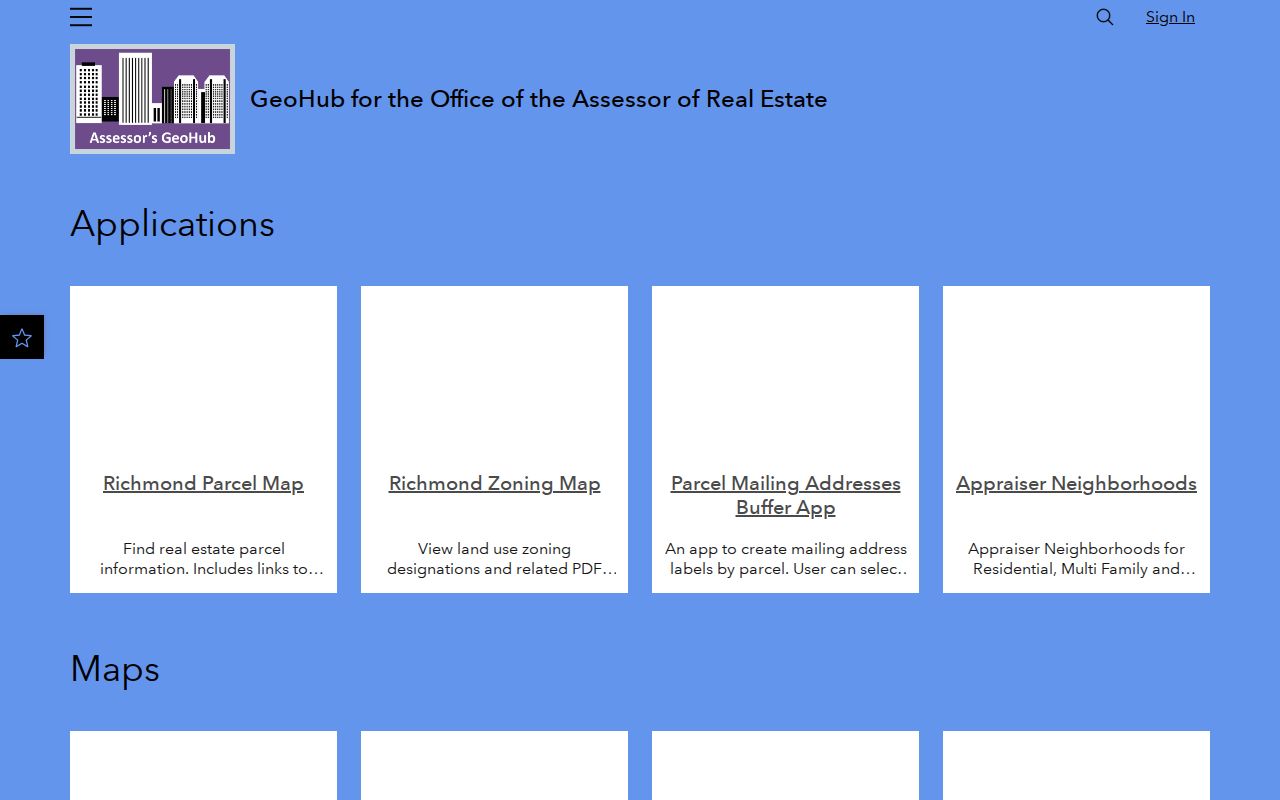
For one parcel's value, rely on the Assessor record and the annual notice. For a broad pattern, use the map layer and keep its scale and date in mind.
Richmond City Neighborhood Value Context
No single value trend describes Richmond City. The Fan, Museum District, and the Monument Avenue corridor carry older housing stock and narrow lots. South-of-the-river neighborhoods and north-side postwar districts follow different patterns. Preservation rules add another layer in Jackson Ward, Church Hill, and Union Hill. Historic review there can shape exterior work. So a citywide figure rarely tells you much.
For a real comparison, use the city's own value-change and property-transfer layers. Skip the statewide or metro number. Richmond City publishes no single parcel count or one citywide percentage trend. A value map can show where property records shifted. The Assessor's annual notice pins a value to one parcel number.
Richmond City Parcel Value Changes
A new legal parcel rarely appears the day its deed is recorded. The city requires a recorded deed for a split. A plat or survey may also be needed. Assessor CAMA/GIS processing then brings the parcel onto the next year's notice or tax bill. Until then, a total assessed amount may reflect an older parcel shape while the deed records show a newer conveyance.
Sharp value swings deserve a second look. Check whether the parcel was split or merged. Check the legal description too. The improvement record may also have changed. The Assessor GIS team maintains parcel mapping and subdivisions, and official tax maps can be requested, though the office builds no custom maps. Never compare two totals until the parcel number and assessment year line up.
Richmond City Value and Taxable Amount
The city Finance page lists a rate of $1.20 per $100 of assessed value; confirm the rate for your bill year before estimating a charge. Exemptions or relief can shrink taxable value. Special assessments may add separate amounts. The Assessor notice states what value was assigned. Finance's tax bill states what the account owes.
The two figures often differ because relief programs, exemptions, or special charges change the account. Richmond City lists exemption classes, including disabled-veteran and older-adult or disability programs. A tax total is never a stand-in for assessed value or a sale appraisal. Keep those questions separate.
For exemption rules, billing, payments, or an appeal deadline, see the Richmond City property tax records page. It walks through the Finance account and the Assessor review process without reading the bill as a market estimate.
What a Richmond City Assessor Value Is Not
An assessed value is not a sale price, a lender's appraisal, or a title conclusion. It comes from annual mass appraisal. Individual sales can land far from it. Dates, property details, and transaction conditions all differ. Richmond City's assessment roll is a tax record. It works well for comparing public values across parcels. But it cannot replace an independent appraisal for a specific deal.
Owners who disagree can request an Assessor office review within 30 days of the notice. After that, apply to the Board of Equalization by November 30. Hearings begin the following January. A direct court appeal stays open for three years from the assessment year. However, an older assessment requires a prior-year written disagreement. Follow the live city notice for the current form and evidence rules. Its appeal instructions govern both. A value map is not the appeal record.
Value vs price. Richmond City’s assessed value is for the annual tax roll and is not what a property will sell for. Use a qualified appraiser for a transaction-specific valuation.