
What Richmond City Property Tax Records Show
Richmond City splits valuation and billing between two offices. The Assessor keeps the annual market-value assessment, the ownership file, parcel characteristics, and exemptions. Finance handles the money side. It sends two real-estate tax billings each year, takes payments, and pursues delinquent collections. The trail below names the right office for each question. That way, nobody mistakes an assessment amount for a tax balance.
| Field | What It Shows | Where |
|---|---|---|
| Owner and parcel | Current roll name, primary address and parcel traits | Assessor of Real Estate |
| Annual assessment | Market-value land and improvements, plus visible relief flags | Assessor notice and property search |
| Tax bill | Finance billing, payment and account questions | Real-estate tax page and InvoiceCloud |
| Delinquent account | Collections actions, possible lien, suit or seizure | Finance Delinquent Collections and Clerk records |
| Appeal record | Office review, Board of Equalization or court path | Assessor forms and Richmond Circuit Court |
Think of the assessment as an annual estimate feeding the tax system. A Finance bill layers on the rate, any exemptions or special charges, and payment status. A recorded deed proves a transfer happened. It shows its consideration when reported. It does not show the current tax balance. For owner or parcel-number details, start with the Assessor. Then carry that same parcel key into your Finance inquiry.
Richmond City Assessor and Finance Roles
The Assessor and Finance are separate offices with separate duties. The Assessor keeps the land book, the owner file, parcel features, current sales, annual market-value assessments, exemptions, and the appeal process. Finance builds its real-estate billing on that assessment and manages payments, escrow questions, and delinquent collections. One trap worth noting: correcting a bill's mailing address does not change the deed or the Assessor's legal ownership data.
For assessment or owner-card questions, contact the Assessor at City Hall, 900 E. Broad St., Room 802, Monday through Friday, 8 a.m. to 5 p.m., at 804-646-7500 or asktheassessor@rva.gov. The Assessor publishes data-request information, so confirm the current form fields and charges with the office directly. For a large extract, describe the fields and date range you need and request a cost estimate.
For billing or payment, call Finance at 804-646-7000 or use RVA311 and the real-estate section of its site. Real-estate taxes are their own account. Do not confuse them with BPOL, meals, personal property, or utility accounts.
Richmond City Rate and Two Bills
The Finance real-estate page posts a rate of $1.20 per $100 of assessed value. It also states that property tax is billed twice each year on non-exempt real estate. Confirm the rate on the live Finance page. Check the payment dates for the tax year you care about. Never apply a current rate to an old assessment. Never assume you can reconstruct a bill without exemptions and special charges. Those items change the total.
The image links to Richmond City Finance real-estate tax information. That page posts the current rate and bill schedule. It also lists payment options.
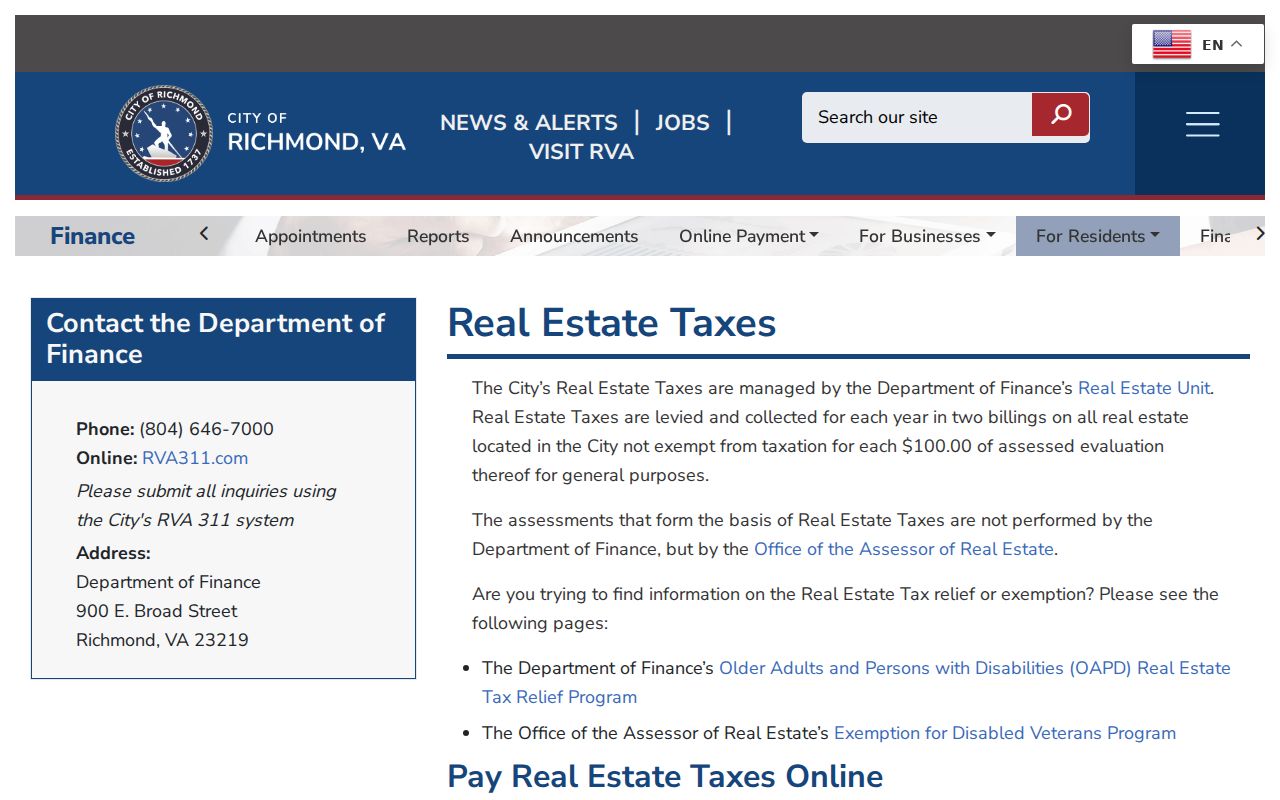
Finance manages payment and delinquent accounts. The Assessor determines the assessment. If a bill looks wrong, compare its parcel and tax year against the Assessor card, then ask Finance about the account line rather than treating the amount as proof of value.
Looking Up a Richmond City Tax Bill
Finance links to real-estate tax information and an InvoiceCloud payment route. The city documents no public tax-account search fields. Do not count on a parcel-lookup control there. Start with the Assessor's address and parcel number instead. Then use the current Finance page. Or contact Finance or RVA311 with the parcel and tax year in hand.
- Identify the Richmond City parcel through the Assessor’s public Property Search or ask the Assessor for help.
- Copy the 11-digit PIN and note the tax year and primary property address.
- Open the Finance real-estate tax page and follow its current bill or payment route.
- Review the applicable bill, payment status and any delinquent-collection notice with Finance.
- Keep the bill and receipt with the Assessor notice and deed date for later comparison.
Real estate in the city is billed twice each year. Do not assume a lender, mortgage company, or mailing-address change updated the ownership record. Richmond is explicit on this point. Address changes for real-estate taxes go through the Assessor, not Finance.
The image links to the official Richmond City InvoiceCloud tax-payment destination. Remember that a payment screen is just a transaction route. It is no substitute for the Assessor's value notice or a deed.

If the portal does not show what you need, Finance can be reached at 804-646-7000 or through RVA311. Ask which tax year and parcel details they need before sending a written question.
- Assessed value
- The Assessor’s annual market-value estimate used in the tax system.
- Tax rate
- The amount applied to each $100 of assessed value in the posted rate schedule.
- Exemption
- A program classification that may reduce a tax obligation under local rules.
- Tax lien
- A recorded or statutory claim connected to unpaid tax; check Finance and Clerk records.
Richmond City Exemptions and Relief
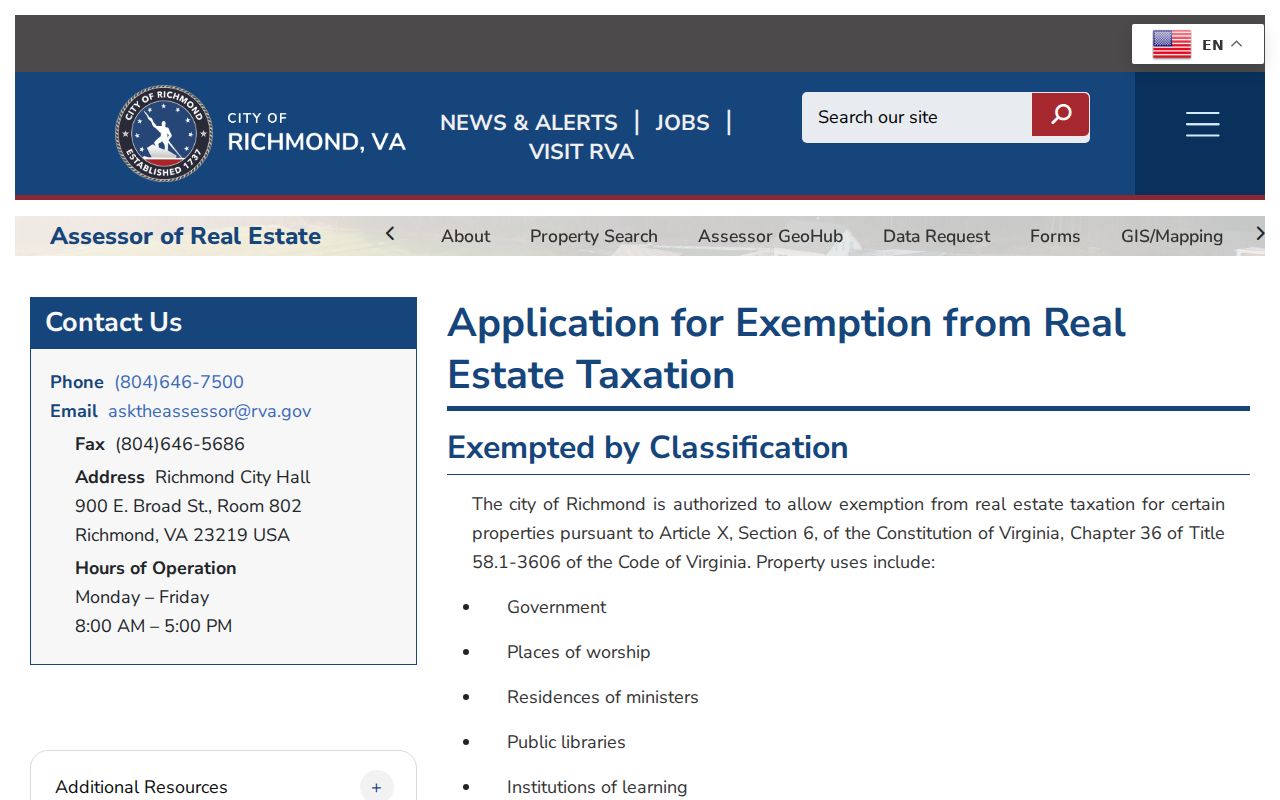
Tax relief lowers the amount due under specific eligibility rules. Richmond's Assessor lists exemption classes. These include disabled-veteran relief and programs for older adults or people with disabilities. Eligibility, documents, and filing periods vary by program. A flag on a parcel does not mean every tax vanished. Confirm whether relief applies to assessed value, taxable value, or a bill charge.
The city's exemption information sets a July 1 filing deadline for the described application cycle. The page does not list every form field or supporting-document checklist. So use the current application and confirm details with the Assessor. The department can also tell you whether a parcel carries a visible exemption flag.
The image links to the Assessor's Richmond City exemption information. It covers program classes and disabled-veteran details.
Before assuming two neighboring homes should owe the same tax, compare their parcel features, exemption status, special district charges, and assessment year.
Appealing a Richmond City Assessment
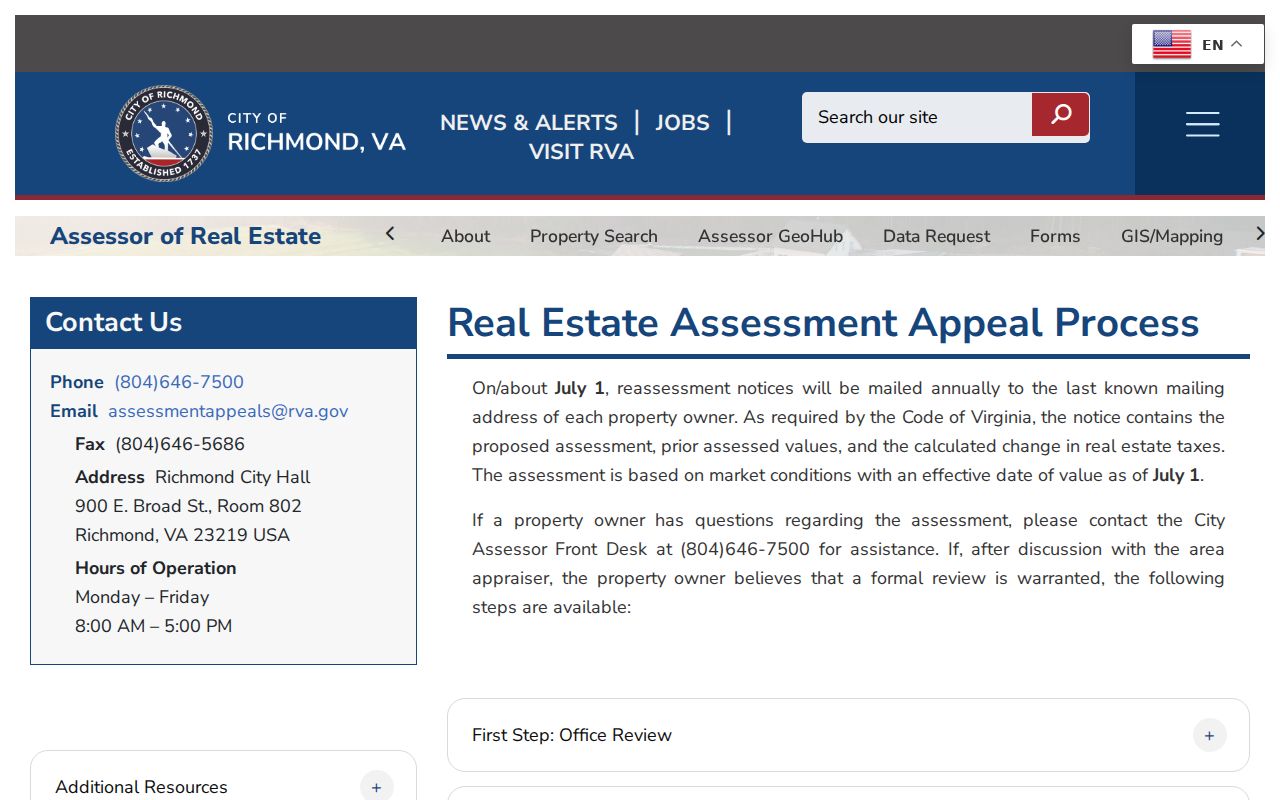
Richmond sets its annual assessment at a July 1 effective value date. The notice itself goes out around the same day. Disagree with the number? The first step is an office review by the Assessor. That review must be requested within 30 days of the notice date. Bring fair-market-value evidence or comparable assessment information to support the case. A staff appraiser then answers in writing.
Appeal window. The Board of Equalization application is due by November 30 of the calendar year, with hearings starting the next January. Check the current Assessor forms and notice for the applicable dates.
The Richmond City appeal-process instructions lay out every route. They cover the office review, the Board of Equalization, and court options.
Some owners skip the administrative path entirely. A direct appeal can go to Richmond Circuit Court. It must be filed within three years of the assessment year. Prior-year appeals work differently. For one, the owner must have filed a written notice of disagreement. That notice must come during that tax year. The official form lists the fee, signature and attachment rules. Use the current version rather than guessing.
Richmond City Delinquent Tax Records
Unpaid Richmond City taxes trigger Finance's Delinquent Collections process. That can mean tax liens, outside collection attorneys, civil suits, or seizure of the property. Payment arrangements sometimes help. But the current balance has to stay current. Finance publishes no parcel-by-parcel delinquent account lookup. So ask the department directly about a specific tax year and PIN. A delinquent notice is not a finished foreclosure or tax sale. To confirm an alleged sale, check a recorded deed, a trustee instrument, or the Circuit Court case file. A property can carry a lien or collection action without any sale ever happening. Recorded liens live in the Clerk's land records. The court file shows the outcome. Keep every written notice and payment receipt. If a lender normally receives the bill, verify the Assessor mailing address. Check the Finance account separately. A mailing error or import glitch never changes legal title.
Richmond City Tax Bill Data Corrections
Recent Finance notices show why a bill envelope is not an ownership record. In May 2025, the department disclosed a mortgage-lender data import failure affecting at least 33,000 records. The failure sent bills straight to residents instead of their lenders. A month earlier, in April 2025, it reported rebate errors on roughly 8,300 of nearly 60,000 checks. Those errors touched parcels sold in 2024. They also touched parcels that never existed that year. None of this means the assessment roll or the recorded deed is wrong. It does show that billing imports, lender escrow routing, and payee records can all need fixing. So compare the pieces: the bill, the Assessor's current owner field, the latest recorded deed, and any Finance correction notice. The tax bill account belongs to Finance. For the property mailing address, Richmond sends owners to the Assessor. The city's 2025 billing notice explains the mortgage-import problem. Treat it as one dated example, not proof that every current bill is affected.
Richmond City Special Tax Charges
A Richmond City tax bill can carry charges beyond the citywide property value calculation. The Assessor's GIS material maps several special-assessment districts. These include General, Consumer Broad, Consumer Shockoe, and Riverfront Overlay groupings. An Area Tax also applies to legal encroachments. Area encroachments cost $0.25 per square foot. Linear ones cost $0.25 per linear foot. Finance bills that charge annually, while Planning or Public Works handles the permits and paperwork. Always read a charge against its parcel, district, and permit or map context. A zoning layer or assessment dashboard is not the legal assessment notice. The assessed-value change map is a comparison tool. When challenging a value, rely on the mailed notice and the appeal calendar. Assessed value and sale price differ. For that difference, see the Richmond City property value page. This tax page stays with the bill, the relief, and the appeal record.